Tuesday, 20 January 2015

CRIME & PUNISHMENT 2020AD


Three week programme of low budget visions of law & disorder in the near future. 

Rarely/never screened.
Tuesday nights. 
Free entry. 
Two films per week, 7PM -> 10PM.

Venue: LongPlay (318 St Georges Road North Fitzroy 3068)

W E E K 1

Droid (1988) http://upload.wikimedia.org/wikipedia/en/4/45/Droidvideobox.jpg
Cybernator (1991) http://www.vhscollector.com/sites/default/files/vhscovers/cybernator-vista1%20(VHSCollector.com)%20.jpg

Droid was cut together from a porno rip off of Blade Runner (Cabaret Sin,1987) and takes place within a garish, neon sexdrome inhabited by bombed out cyberpunks. Defies any conventional notion of 'meaning'. Economical gesturalism at it finest. Cybernator marries tired hard-man/lone-cop tropes to a threadbare aesthetic around human/cyborg relations in the near future. The budget mis-en-scene closer to the lived future under our present regime of economic rationalism than your standard dystopia.

W E E K 2

The Comic (1985) https://www.youtube.com/watch?v=B3htEmUIUSo
Split Second (1992) https://www.youtube.com/watch?v=B3htEmUIUSo

The Comic is a singular work by UK director Richard Driscroll (presently in prison for massive financial fraud). Depicts the slowly crumbling reality of a murderous stand up comedian in a droll future fascist state. Atmospheric and dreamlike with strange imagery and dark ambient soundtrack. Split Second is a mid-budget, subaquatic noir set in a submerged future London. Quickly falls into a knot of half-baked cinematic cliques. Features Rutger Hauer and Kim Cattrall.

W E E K 3

Crime Zone (1989) https://www.youtube.com/watch?v=7X6BJfFTAac
R.O.T.O.R. (1987) https://www.youtube.com/watch?v=XJV3qFsaozE

Crime Zone is another in a long line of police state futures. Featuring Sherilyn Fenn and David Carradine. R.O.T.O.R. is an incredibly weak and tedious mishmash of Terminator and Robocop filmed in Dallas, Texas. The core of the movie is not against autonomous robotic execution but budget cuts to the police force….?!

Monday, 19 January 2015

Modern Jazz in Ivanhoe: Studio One at Club Le Regale, 1956.


(The Argus, 18 & 14 Jan. 1956) 

I've put together all the fragments of information I've come across on Studio One, one of the early dedicated modern jazz clubs from Melbourne during the mid 50s. Established by Mike Coniston Nash & John Moore in 1956 Studio One was held on Tuesday and Sunday nights at the Club Le Regale in Ivanhoe, though I'm not clear on if Studio One managed to stay in operation beyond 1956 .Regarding the organisers I couldn't find any information on John Moore, though Mike Coniston was a young emigrant from London who was later involved in the art forgery market helping to sell fake Streeton's. A newspaper report on the fraud circle referred to him as as having once been a 'jazz entrepreneur'. While Horst Liepolt and the Jazz Centre 44 in St Kilda constituted the physical and psychic centre of modern jazz activity in Melbourne Studio One is an example of how the scope of musical activity in the period extended to a host of un(der)documented small coffee spaces, after hours clubs, art galleries and informal house shows. Beyond a passing note in Bruce Johnsons Oxford Companion to Australian Jazz (page 120 to be exact) I haven't come across any references to the club in the extant literature on the period, though Brian Brown does recall that his group "really started in a church hall in Heidelberg".


(Music Maker, April 1956)


(The Argus, 11 Sept. 1956)

I have no idea what the atmosphere of Studio One was like. Whilst the vision of the Jazz Centre 44 retrospectively presented is as a sort of casual interzone by the standards of the time (Pianist Dave Martin divided the audience of Jazz Centre 44 into three groups; "casuals who heard something strange…then there were two groups of regulars. One of these was middle class, interested in the arts generally…the third group was a bunch of very rough diamonds") I suspect the atmosphere of Studio One may have been closer to the more explicitly middle class atmosphere that characterised most of the general jazz activity in the period. Nestled away in Ivanhoe, an older, affluent outpost above the suburban expansion taking place in nearby Heidelberg, it sat quite distant from the supposed seaside sleaze and transgressive social milieu of St. Kilda. The atmosphere suggested by the advertising was of cultivated exclusivity, a specialist space. A report from The Argus notes "club cards and memberships have been planned to control the patronage". This chimes with a passing comment by Jeff Hawes, reminiscing on the Melbourne casual jazz dance scene in the period. Hawes noting that the formula for jazz clubs and dances was "…a catchy name, produce a key-ring medallion (which was the only way admission could be gained), sell the medallion membership for ten shillings or a pound, screen the patrons (no rough-necks), provide soft lighting, trendy decor, and no booze (only soft drink)"(from VJAZ #60, 2013, available here). Here membership cards were a mechanism to screen out undesirable types, presumably bodgies and rockers. On this theme of 'in' and 'out' amongst youths is a small contemporary article on how Eric Westbrook, director of the National Gallery of Victoria planned on 'dealing' with what was perceived as the undesirable patronage by Bodgies of the gallery, demarcating the borders of access. (It should be noted that for older people in 1955 the term bodgie doubled to cover the nascent middle class jazzers and the more broadly working class rockers. Smaller, specialist clubs such as Studio One could be argued to be the point at which a distinction was beginning to be made between the two in the popular imagination as the centrality of larger dance halls were side stepped.) 


(Mooma Rhythm Fiesta programme, taken with thanks from the Victorian Jazz Archive)


(The Argus, 2nd Feb. 1956)

 Studio One was host to the core of the younger musicians whom constituted the vogue vanguard of cool jazz and hard bop at the time, including Graham Morgan, Brian Brown, Keith Hounslow, and Peter Martin. They constituted the house band, the Modern Jazz Quartet/Combo. The Music Maker article notes that "opposition may come, not only from the general public, but from the local musicians themselves, some of whom may not understand, nor want to understand, these fresh, progressive improvisations in jazz music." These musicians were later closely associated with Jazz Centre 44, performing with their own individual groups. Beyond Studio One at this point Morgan and Brown were involved in the Downbeat jazz concerts staged by Bob Clemens, and their Modern Jazz Quartet had performed at the Rhythm Fiestas that were part of the early Moomba Festival. The Music Maker article also refers to "recording contracts already signed", which may be hyperbole on one hand, though Brian Brown would appear later in 1956 on Harold Blairs Australian Aboriginal Songs, playing saxophone ('roofter') and assisting in the arrangements. This was released on Score Records whom would also release Browns Australian Jazz 7" EP in 1957. 

I must also send a thanks out to the State Library of Victoria where I am presently embarking on a AGL Shaw Summer Research Fellowship. The above copy of Music Maker is photographed from their collection of periodicals, hopefully I will be able to post a further things I come across in their collection over the next month.


Wednesday, 31 December 2014

Friday, 14 November 2014

REDUNDANCY - NEW TAPES


#9 A.J.A. c40

Idiosyncratic electronic music from members (present & past) of Repairs. Obstinately an oblique tribute to Beckett & Fagan. Excerpts of neon tube interiors & electrically lit late night parks. 

#10 Nicky Crane c20

Fractured electronic music by journeyman James Vinciguerra. Internal monologues made external. Doesn't really sound like anyone else. Maybe if Graham Lambkin teamed up with the Burrell Brothers or something…?!

#11 Striker c20

Garage band NWOBHM; hard-ware humans & MIDI software. From the depths of Gippsland, circa early 2000's. Classic sounds for cruising the decayed highways.


Prior releases possibly available, NO BULK ORDERS.
$5 each.

Wednesday, 12 November 2014

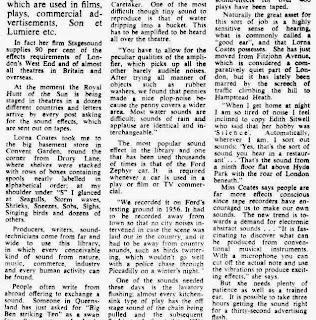
Lorna Coates and Commercial Concrète


'A sixty thousand sound girl' The Canberra Times, 8th October 1966.

I cannot find much concrete biographical information on Lorna Coates but she was originally from Adelaide, later moving to London in the early 1950s. She was involved in creating effects for radio stations in Adelaide during the 1940s and 50s and by the 1960s she had provided effects for the BBC
and was working for Stage Sound creating commercial musique concrète. In this she was part of a wider (though small) group of expatriates from Australia involved in commercially based experimentation such as Don Harper, Don Banks, and Dudley Simpson. There is not much further information available on Coates, though she was friends with writer Elizabeth Salter, also from Adelaide with whom she shared a London flat with in the 1960s, and English eccentric Edith Sitwell (whom Salter wrote a biography of). The National Library of Australia also has a small clippings file for Coates though unfortunately I can't find any documentation of her sound work ever having been published. I've also included some articles documenting the recording studio she opened in London in the 1970s.


Interview (1999) with Barry Hall from the Once Upon A Wireless: An Oral History of South Australian Radio Project


Coates is another example of how the early history of electronic music was invariably tied up with commercial rather than expressive avenues. Whilst there were musicians with an interest in its sonic and expressive possibilities much of the production in itself was as a complimentary component of other works. Whether it be radio plays, theatre music, film soundtracks, advertising jingles and so on (in Australia, at least, this further reiterates the point that 'modernism' often entered the local sphere via the backdoor. An integrated component of mass production and consumption rather than as rarefied 'art'). The functional and incidental nature of its production working to obscure its very existence. It was not understood to be creative work in the nominal sense, though the recent history of Delia Derbyshire and the BBC Radiophonic Workshop are the prime example of this side-lining being amended and reversed. 


'Station Announces Armistice Day Features' The South Australian Radio Call, March 7 1945


'Diary' Studio Sound and Broadcast Engineering, November 1973.


'Diary' Studio Sound and Broadcast Engineering, January 1974.

Monday, 20 October 2014

Sunday, 5 October 2014

Beatnik & ET.


Lovell Jones 'Beatnik', Australian Women's Weekly 1961.