Friday, 9 May 2014

‘A Hard Night’s Jazz’ & The Fat Black Pussycat, 1963 - 1966


Above is an extensive article on the jazz and folk scene in Melbourne from The Age, August 19th, 1964 by Leonard Radic, focusing on the 'vibe' of the establishments and their patrons, as opposed to the music and musicians. As an insight into youth night life it provides a grasp on  the atmosphere prior to the changes in alcohol legislation, that would pave the way for the 'beer barns' of the 1970's, and the growing secularisation of youth culture. The article is also pertinent in that it was written right on the cusp of Beatlemania - the beginning of the end for folk and jazz as major youth currency. In Melbourne the switch towards 'rock' took place largely within the club sphere, as discotheques quickly replaced jazz spots and the coffee houses. Keith Glass touches on this transition in his memoirs 'A Life in Music';

"In the wake of the beat music explosion, every jazz club in Melbourne is changing it’s music policy to accommodate young hopefuls with guitars and amplifiers. As ex-jazzers (that peculiarly Melbourne cult group deserves more time/explanation than available here) we’ve already got the long hair and therefore the jump on the more established, instrumental based regular "rock" groups who see this new thing as a passing fad. Soon we are working at Stonehenge in Beaumaris, Harlem in Caulfield and Penthouse in Ormond. Mentone Rock has become Mentone Mod, Jazz Centre 44 in St. Kilda is billing R&B nights each week, ditto the Fat Black Pussycat in South Yarra and dances such as OddMod at Kew Civic Centre are raking it in for the promoters while the bands are just excited to be there."

 One example of the transition between 'jazz' and 'beat' is the aforementioned Fat Black Pussycat, presumably the South Yarra venue mentioned in the article. Opening as a modern jazz venue in 1963 it provided a platform for the likes of the Brian Brown Group, The Heads (later the Bernie McGann Quartet) the Barry McKimm Trio, the Alan Lee Quintet, the Bob Bertles Quartet, and the Heinz Mendelson Quartet. Most were refugees from the Jazz Centre 44, in wake of clubs move towards trad jazz after its founder, Horst Liepolt, left for Sydney. It only lasted three years, having folding by 1966 and converting into one of Melbournes first discotheques, with a strict 'rock only' policy. 

The most 'known' of the groups that played at the Pussycat was the early incarnation of The Wild Cherries, pre-Lobby Loyde. A transitional act, members Les Gilbert & Kevin Murphy were modern jazz fans with a vogueish embrace of electrified r'n'b. Gilbert describes their experience with the venue, "The Fat Black Pussycat had been a jazz venue and was run by an American guy called Ali Sugarman – very much along the lines of a New York jazz club. With declining audiences he decided to change the music to stay in business and for some reason I can’t really remember, we were asked to perform the first night of its conversion from jazz to…I struggle with finding a word for what we called our music at the time,".


(The Age, Dec 11, 1964)

(Lot's Wife, Dec 2, 1965)
 
Though this gossip piece from The Age claims the venue had already moved on from jazz to mod by '64 (presumably not the jazz loving mods though) the venue would later be managed by Adrian Rawlins between 1965 and 1966, continuing to promote experimental jazz and poetry until its closure.

 (The Age, March 5, 1965)
 (The Canberra Times, Nov 4, 1966)
 (J.A. Hoffberg, "Fluxus Film and Sam: A Conversation with Jeff Perkins", 1998)

I’ve also included what information I could find on Ali Sugarman, an elusive (shadowy even?) figure in the narrative of jazz in Melbourne who came to tragic end. Like Horst Liepolt, Sugarman was another transnational influence on Melbourne cultural life in the post-war period, via the nexus of the ‘jazz club’. That he was tangentially connected with the Fluxus scene in New York is also an intriguing point, and may go someway towards explaining his willingness to promote the likes of Barry McKimm during the period they were embracing techniques influenced by John Cage and Ornette Coleman. Whilst jazz and ‘jazzers’ were the in thing I’m not sure how far towards that end of the spectrum audiences went (not very far, and would explain the change in booking policy) Pianist Chuck Yates provides an insight into his 'New yoik' ways, "The club was run by Ali Sugaman, who was later shot dead in New York. He was an incredible cat though. He was the first person I knew who would say any word in front of anybody. At that time in Melbourne nobody swore in front of women." I've read elsewhere that swearing in front of a 'blokes' 'girl' at that time in Australia was enough to cause a fist fight.... Perhaps The Fat Black Pussycat could be thought of as a small slice of New York in Toorak, perhaps?

In wider terms the shift towards rock proved disastrous in terms of commercial and social infrastructure for modern jazz in Melbourne, unlike folk and trad jazz, which both managed to sustain support (see W & G, East Recording Company, Score Records, Swaggie Records, The Seekers, Trevor Lucas, Red Onion Jazz Band, Frank Traynor etc. etc. ) The changes in taste in Melbourne away from jazz saw kept it absent from the official record. Unlike Sydney, which had the El Rocco and the major record labels such as Columbia and EMI, Melbourne had no venues, or labels - independent or major. Presumably this wasn't helped by the fact that artists such as Brown, McGann and McKimm, like their counterparts in Sydney, were at the height of their explorations in avant-garde and the 'new thing' (I say presumably as there are few available recordings to consult) That there  no one had a little money or interest in running something along the lines of ESP Disk is a shame as there was enough avant-garde activity during the period to sustain something. The only supporting documentation of artists in the 1960's period that I know of are two tracks by the Bernie McGann Quartet tracks on the Australia Jazz '67 compilation, the two EP's by the Alan Lee Quartet & Quintet from '61 and '63, the Max Reed Trio's EP from 1963, some of the tracks on Jim Minchin's 'Move 2 Mix' album, and there is one or two 'modern' style tunes on a live LP by Len Barnards Modern Jazz Group with Keith Hounslow on W&G from the late 60's, though mixed in with more 'trad' styles. I've read mention of a release by the Brian Brown Quartert, "Live in Tasmania", from 1969, but can't find any evidence that it actually exists. There are also archival recordings of McKimm along with Robert Rooney and Syd Clayton available on the Artefacts of Australian Experimental Music 1930 - 1973 compilation. 

The lack of venues or audience interest saw a real retreat from experimental music for several years in Melbourne, until the Carlton scene swung into life, and the establishment of the Victorian Jazz Club in 1969 provided some space for artists like Alan Lee and Brian Brown, though McKimm etc. had moved away from jazz into 'new music' circles, such as the International Society for Contemporary Music, and into the nascent experimental theatre scene around La Mama. 

Wednesday, 23 April 2014

Monday, 3 March 2014

The Guzeek, or, the Gunfire Sound Effects Generator

(The Sun Herald, October 24, 1954)


(BBC Engineering Division Monograph: Radiophonics in the BBC, 1963)


Whilst researching the early (pre?) history of Australian electronic music (that is to say, the space between Percy Grangiers experiments in Free Music from the 1930's and 1940's and Keith Humbles establishment of the Electronic Music Studio at the University of Melbourne in 1966, and Val Stephens appearance on the compilation Electronic Music issued by Folkways in 1967) I came across this intriguing news report on the Guzeek, or, the Gunfire Sound Effects Generator. This small, unassuming machine was an electronic white noise generator designed to, as it suggests, imitate the sound of gunfire. Utilised in Army training exercises during 1954 to produce a sonic assault, and reduce the damage inflicted through ammunition on the Sydney National Park, sitting in as the theater of war, the Guzeek was hooked up to a large PA system installed throughout the park spitting out an encyclopaedic level of assault weapon imitations into the serene soundscape of the park - a hybrid of a mechanical Lyre Bird and some shell shocked veteran out of a Samuel Fuller film.

A strange inheritor of Luigi Russolo's Intonarumori's, the Guzeek was designed by the engineering team at the 2UE radio station though I am uncertain whether the machine they constructed was an original creation or a modification of a similarly named machine designed that same year by the radiophonic engineers at the BBC (soon to be united under the title of the BBC Radiophonic Workshop…). To experience what the Guzeek may have sounded like there is available online a digital approximation of the BBC's Guzeek, available here, digitally reconstructed by a team who have recreated a range of Radiophonic devices to play online.

Monday, 17 February 2014

Jazz, LSD & Lightshows in Australia: Graeme Lyall, Gordon Mutch & Psychedelia '67


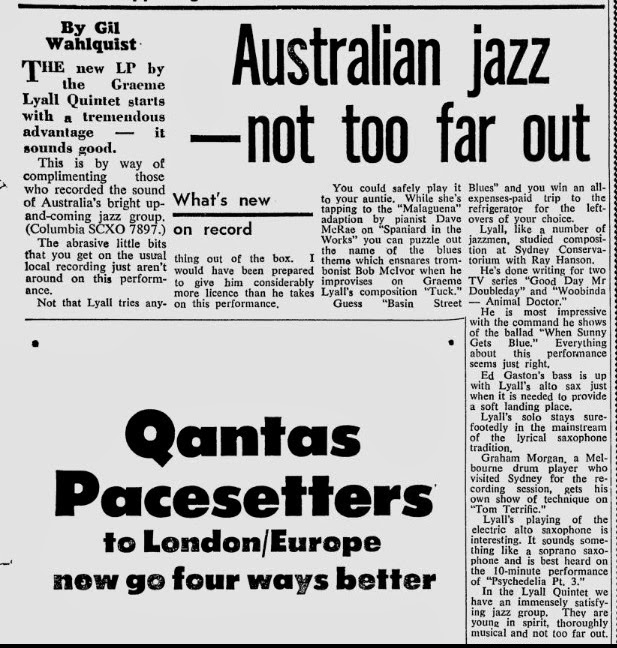
 Though the later half of the 60's and the rise of psychedelia in Australia has been relatively well covered it is surprising to find both Peter Mudies "Ubu Underground Cinema" and Iain McIntyres "Tomorrow is Today" - both comprehensive to a sometimes exhaustive level in their documentation of the period - omit any reference to Graeme Lyall's 'Psychedelia '67. Strangely there has been no subsequent documentation or even mention of it anywhere. Performed in September of 1967 at the Cell Block Theatre in Sydney and The Canberra Theatre in Canberra, it was arguably the first large scale, self consciously (and self avowedly) psychedelic total environment to take place in public in Australia. Conceived as a three part jazz suite based on the movements of an acid trip, it was performed by the the crème de la crème of the Sydney modern jazz scene in collaboration with the extended Ubu Films group handling live light and film projections.

Graeme Lyall started off in Melbourne in the late 1950's playing tenor sax in the rock and roll group The Thunderbirds whilst being actively involved in the modern jazz boom that had emerged almost in tandem with the rock n roll craze, Moonlighting at the Embers nightclub and the Jazz Centre 44 (sitting in on their Sunday afternoon sessions, in-between matinee and evenings shows with the Thunderbirds) Lyall was a part of the small exodus to Sydney that took place in 1960 (fellow Jazz Centre habituates such as Horst Liepolt, Stewie Speer and Keith Hounslow also made the migration north) and commenced studies through the Sydney Conservatorium. He naturally fell in with the El Rocco scene (Sydneys more successful, long running equivalent to the Jazz Centre 44) and performed on Judy Baileys "My Favourite Things" (CBS, 1965), the compilation Australia Jazz '67 (Columbia, 1967), Don Burrows ‘2000 Weeks’ (Columbia, 1969) the Charles Munro Jazz Orchestras "Count Down" (EMI, 1969), and John Sangsters "The Joker Is Wild" (Festival, 1968).


The musicians who participated in ‘Psychedelia’ included all those above whom Lyall had been playing with in Sydney; Don Burrows (clarinet and alto flute), Charlie Munro (alto saxophone) John Sangster (vibraphone) Judy Bailey (piano) along with Neville Blanchett (trumpet), Bob McIver (trombone), Barry Stewart (drums), and Cliff Barnell (bass). All had been influenced, to varying degrees, by the new thing that had been coming out of America over the decade, and ‘Psychedelia’ seems one of the more audacious, large-scale flirtations with free jazz and improvisation at that point in Australia.

Though the music had been scored by Lyall the 'jazz happening' was very much a three way venture between Lyall and lighting artist Gordon Mutch, along with classical concert promoter Donald Westlake;

Gordon Mutch, an active and ever present footnote throughout the 1960's underground scene in Sydney, hasn’t had much concretely written about him. As a teenager he had moved from Perth to Sydney and fell in with the bohemian milieu of the Bodgies, Widgies and The Paddington Push that defined the late 1950’s/early 1960's in parts of Sydney. Principally involved in the theatre scene (including the controversial debut staging of Alan Seymours "The One Day of the Year") his approach mutated between '63 & '65, becoming more probing and free form and less involved with the theatre per se, as generally was taking place with his associates Albie Thoms and Clem Gordon - he was involved with, among others, The Human Body, Ken Kerney, Black Allen, Ubu Films and the PACT Theatre. A jack of all trades he pursued film making with the experimental short Hallucegenica ('68) and he unsuccessfully attempted to make a feature length film, Once Around The Sun an experimental document of the Ourimbah Pop Festival (recently completed by David Hugett in 2012) as well actively working as a painter and amateur musician. His friendship and musical collaboration with Indigenous folk singer Black Allen transformed into more urgent expressions in the early 1970’s as both became key figures in the burgeoning anti-Nuclear movement, instrumental in the formation of Australian Greenpeace.

Donald Westlake, much older then either Lyall or Mutch, was a transplant from the upper crust of 1950's Perth society who had become the principal clarinet player for the Sydney Symphony and a lecturer at the Conservatorium. Though all the contemporary news reports paint him very much as the odd man out, ‘the straight cat’, he was relaxed enough to involve himself in the project (and likely had a keen eye for business if the audience figures were anything to go by…)

The key concept for the 'jazz rhapsody' was the recreation/exploration/evocation of an acid trip. A tired idea, even then, I suppose it was a convenient vehicle for Lyall to stake his own generational and social connection with what was 'going on' (he was only 25 at the time) The relative size of Sydneys music community ensured extended connections of some in the jazz scene, like John Sangster, with the counter culture. That is to say jazz was a part of the counterculture, one of the many threads in the fabric. Jazz had yet been neutralised from youth culture - it still remained in currency. Albie Thoms, one of the principal figures in Ubu, talked about their light shows being “an extension of jazz improvisation, the idea rather then the music,” (he also lived in the same building as Sangster - upstairs from the El Rocco club) Lobby Loyde described his experiences touring Sydney with The Wild Cherries in 1966, “The Sydney crowd was very interesting…People in Melbourne talked about Sydney as this kind of uncouth place, but I found the psychedelic crew up there were way harder and more bizarre…Every time we went to Sydney to play I’d fall into the bad company of all these musicians who were playing jazz and the early sounds of the Sydney underground. They’d pass you silly cigarettes and pieces of blotting paper and say “Try this man!”.…I am ignorant of the history of LSD in Australia though it presumably started, like overseas, as ‘medicine’ open to high end doctors that slowly spread outward as word spread (LSD was not banned in Australia until '68, I think) If the likes of Peter Sculthorpe were receiving LSD therapy in Hobart circa '62 (care of Dr. Bert Engisch, a strange footnote of Tasmanian ‘society’, he was also doctor to the Drysdales) you would think that it would have well and truly penetrated Sydney at that time, and would’ve been truly ingrained by '67. I wonder who the anonymous participant in the LSD trial that provided the ‘insights’ that inspired the structure and style of Lyalls writing really were…?


(above articles taken, with thanks, from the Clem Gordon archives)


The enthusiasm for events like this hadn't really taken off yet when Psychedelia was staged. It was amongst the very first wave of ‘happenings’ that took place in Sydney in mid 1967, in the two weeks that followed two other ‘happenings’ organised by the Ubu group took place (the ‘Id Benefit’, to raise funds for members of the Id who had been busted for weed, and the ‘Explosion Factory’ at the Cell Block Theatre). ‘Psychedelia’ was a harbinger of what would come, between ’69 & ’71 (the ‘peak’ period) Ubu were staging their own ‘Intergalactic Festivals’, as well as running their lights shows as a successful for hire business (as were other lighting artists such as Ellis D. Fogg) The chronology for immersive sound & light environments ("son et luimeres") is patchy at times but the practice slowly emerged across '67, though they only really took off as a 'thing' in '68, initially limited as an accompaniment they served as an augmentation or auxiliary aspect of an entertainment environment (see such as Ginza in Melbourne, Foco in Brisbane, and The Factory discoteque in Sydney) Arguably, and lacking any other documentary evidence at present, Psychedelia '67 was the first performance in Australia of a total light & sound environment. The emergence of ‘multimedia’ events in Australia was as a logical extension of the theatre (ie. Opera, musicals, amateur theatre, the ballet etc. the older forms of sound & vision) Relatively modern crossovers had been taking place as far back as 1948 with the early modern jazz pianist from Melbourne Ron Loughhead purportedly staging a ‘bebop operetta” for a modern jazz group and contemporary dancers along with a twelve voice choir, and by the late 50’s Peter Sculthorpe had been creating musique concrete soundscapes to accompany the radio plays of Catherine Duncan in the ABC Studios in Launceston, and Josef Stanislaus Ostoja-Kotkowski was extending his explorations in set design for opera and ballet into independent explorations of electronic music and light & laser art in Adelaide. 


Beyond the newspaper clippings I have no idea what the event actually looked or sounded like. I suspect that the pithy summation of one reviewer, damning with faint praise in declaring it a “light show and some jazz music,” is likely the closet to the truth. Part of the suite did make it to record, 'Psychedelia Pt. 3', the extended 10 minute piece was the opening track on The Grame Lyall Quintet (Columbia, 1969) The album strangely features trombone as well as Lyall playing “electric” saxophone, but none of his top shelf friends are present though the line up did include notably Dave McRae (one of the numerous jazz musicians who left for the UK he played with Matching Mole and Nucleus) and Bob McIver (an American GI who had played with Bryce Rhode) Due to the scarcity of Australian modern jazz recordings I haven’t had the opportunity to hear this either.

I wonder if part of the reason this small chapter in the emergence of psychedelia in Australia has been overlooked/out of sight was partly because of a latent snobbery projected from the central cities. The majority of the newspaper articles on the event seem to have been only written up in Canberra, and then only due to the enthusiasm of their author, Gerry Raffaele, the music writer in the 60's for The Canberra Times. Much younger and open minded in compared to say the staid likes of Fred Blank and Romola Constantino in the Sydney Morning Herald, he had a diverse taste for music (his ‘top discs’ for 1966 is an interesting, forward thinking collection; Ravi Shankar, The Beatles, The Rolling Stones were listed alongside more obscure but interesting choices such as modern jazz pianists Judy Bailey and Denny Zeitlin, folkie Doug Ashdown as well as Ike & Tina Turner and Frank Sinatra?!)

Canberra’s sidelining is understandable given its current state, but during the 1960's and 70's it was an important contributor to Australias post-1960’s cultural evolution, hosting a range of important cultural festivals (for example The Aquarius Arts Festival and Australia ’75 amongst others) and progressive modernists (for example Don Banks and Larry Sitisky taught composition at the university - Banks also assisted in establishing Canberras first electronic music studio in 1972, or Stephen Jones and his important explorations into video art)

At any length it stands as an interesting episode in the tricky, interconnected world of art and music in Australia.

Monday, 27 January 2014

East Doncaster High School 'The Labyrinth' (1981)


 The way in which the post-1960's quality of 'freedom' filtered out from the counter culture into wider Australian culture cropped up in a variety of strange ways, one of which was in the world of high school musicals. School records and musical theatre records from the 1960's and earlier were usually awkward music hall, or religiously inclined mass choral workouts (and confined to the WASPiest of institutions), but from the early 1970's a new type of school musical began to emerge, the 'rock opera'.

The popularity of 'rock operas' (which often had roots, one way or another, in the alternative theatre scene of the 1960's) such as Hair, Joseph & His Technicolor Dreamcoat, Grease, The Rocky Horror Picture Show, and the work of Andrew Lloyd Webber, provided a dynamic source of inspiration for High School drama students and teachers. Though overlooked by many 'collectors' of Australian private press records they are an interesting reflection of the trends taking place in popular musical culture, and a hidden source of local psychedelia and low budget but imaginative narratives - high school students letting their hair out. Some examples include Footscray Colleges 'There's An Elf In My Pocket', 'Cult: A Musical', Chris Neals' 'Man Child', 'The Boy Who Dared to Dream' (featuring arrangements by synthesist Andrew Thomas Wilson) and this record, 'The Labyrinth' by the East Doncaster High School HSC Drama class of 1981.

 (Newspaper clipping from The Age, 19 June, 1981, in the 'Amateur Theater' listings, the only reference I could find of the play)

The Labyrinth' is a mystical, science fiction drama;

"A reflective journey in music, voice and movement, through the maze of patterns of human aggression"….

Prologue:
"Five travellers convicted by 'The Leaders', of crimes of aggression, are sentenced to The Labyrinth - A maze in which people who have shown different types of aggression are trapped - people from different times, places and strange situations. The five travellers may only gain freedom, if they find the exit from the maze - guarding this exit is the legendary 'Minotaur', half man, half bull, a creature believed to be the cause of all human aggression. The legend states that if the 'Minotaur' is found and destroyed, the way to freedom will be revealed. At dawn, the search began…"

 A group effort by the students ("all lyrics written and sung by the cast,"), the instrumental line up includes a full rock band (dual guitars, bass, drums) filled out with synthesizers piano and clarinet, and dual male and female vocals. I presume this was printed in very small quantities, perhaps about 100 (?), for cast, crew, family, and friends who attended the drama.

One of the most curious aspects, as a 'Melbournian', is the fact this is from East Doncaster. For those outside of Melbourne, Doncaster is/was a relatively far flung suburban centre not famous for producing music. Though the urban sprawl in Melbourne has now extended far out beyond the limits of Doncaster, between the 1950's and 1980's Doncaster transformed from a green belt dominated by apple orchards, pioneered by German settlers, into the suburban fringe, the populated hinterland of Melbourne. That may go someway to explaining why this record sounds so….out of date.

Doncaster in 1980, like today, was isolated from the city centre by a lack of comprehensive public transport infrastructure - there is still no Doncaster train line in 2014 - and would have had its own network of discos, nightclubs and bars disconnected from the inner city trends/trendies. The record sounds somewhere about '72 - I am not sure exactly what they were going for, but some tracks are amateur progressive rock, others have a Laurel Canyon vibe, or a scrappy garage rock approach. The only track with any concession to the trends of the day is ‘Bad Habits’, which sounds like their attempt a ‘punk’ song. In the realm of private press progressive rock records in Australia it may not be as accomplished as Rob Thomsett's Yaraandoo or Simon Jones's Melanie and Me, though it is definitely one of the more interesting examples.

Download here.

Tuesday, 21 January 2014

Dudley Simpson & Margot Fonteyn


Dudley Simpson pictured with thee Dame Margot Fonteyn and David Blaire in 1962. Though he worked with Fonteyn and the Royal Ballet for an extended stretch he is 'known' for his work writing & arranging music for the BBC, most notably the incidental music (in collaboration with the BBC Radiophonic Workshop) for Doctor Who between 1964 and 1980.

Australians Women's Weekly, 30th May 1962
The Canberra Times, 27th October 1964

Thursday, 9 January 2014